A bad month doesn't ruin a multi year goal
· Karl

If you run regularly, you will have off weeks: a cold, a work trip, a toddler who has decided that sleep is optional, snow, sleet and ice, a niggle in one calf that you are pretending not to notice. Then the running stops (hopefully just for a few days!).
Often, this leads to you not picking things back up the next Monday. "My streak is already broken", you think to yourself, "the month's total is a write-off", so there is no particular reason to go out on Thursday either. Three weeks later you are not a person who has had a bad week, you are a person who has stopped running.
This failure mode is well documented, but once you know its shape you can build goals that help you run around it (pun intended). This is the basic idea behind In the Long Run:
that long term running goals are good complements to short and medium term ones and that they strengthen each other.
Why one bad week turns into three
Psychologists have been studying this collapse for fifty years. Peter Herman and Janet Polivy described it in the 1970s and called it the what-the-hell effect. Addiction researchers Alan Marlatt and Judith Gordon called the same pattern the abstinence violation effect:
- You set a rule
- You break it in some trivial way
- You then abandon the whole project because it is already spoiled
A small lapse leads to a decision that does a lot of damage:
The abstinence violation effect can be defined as a tendency to continue to engage in a prohibited behavior following the violation of a personal goal to abstain. For example, an individual who has successfully abstained from alcohol, after having one beer, may drink an entire case of beer, thinking that since he or she has “fallen off the wagon,” he or she might as well go the whole way.
Abstinence Violation
The time horizon can make a goal vulnerable to this. If your goal is "run four days a week", then by Friday of a bad week the goal is arithmetically unreachable, and an unreachable goal gives you nothing to do. A streak can be worse still, because its value is entirely in being unbroken, so the moment it breaks it is worth zero. 1
Calendar goals have the same problem in a slower form. Research in The Fresh Start Effect found that people really do start new things at the beginning of a week, a month, a year or a birthday: gym visits and diet searches measurably spike. "New year, new me" is genuinely useful motivation, but it cuts both ways. If a fresh start is what gets you going, then presumably the time before it feels like a write-off, so you spend the second half of a bad November waiting for January instead of running in the November rain.
Why a long term goal survives it
Now put the same bad week against a different goal: 3,112 km down the length of New Zealand on a virtual route, with completion 18 months out.
Very little happens. You are 40 km behind where you would otherwise have been, on a number in the thousands, and the route does not care whether those kilometres arrive this month or next spring. There is no streak to break and no quota to fail. The worst a bad month can do is make the line on the map move a little slower, and the line is still exactly where you left it when you come back.
Part of this is arithmetic, and part of it is how the goal is represented in your head. Robin Vallacher and Daniel Wegner's action identification theory makes the point that any action can be understood at different levels of abstraction ("pounding a nail" or "building a house"). People prefer the higher, more meaningful description. But when an action gets difficult, they drop down to the mechanics, and for hard tasks that is usually the better place to be.
That suggests a useful split. Keep the big goal at the high level. A missed Tuesday is a failure of "run four times this week" but as a step towards "run the length of New Zealand" it barely registers, because the house gets built whether or not you hit that particular nail. The big goal absorbs lapses but the small one gets you out the door on a cold Thursday.
There is a related idea from Arie Kruglanski's work on goal systems: a goal served by many interchangeable means (equifinality, all roads leading to Rome) holds up better than one with a single path to it, and people with several routes to a goal are more committed to it.
A virtual route is about as equifinal as a running goal gets. Road, trail, treadmill, race, commute, holiday, dog walk at jogging pace: every kilometre is the same kilometre to the map. No individual run matters a lot, which is precisely why missing one costs so little.
The part you still have to solve
Long goals have their own well known weakness.
Bonezzi, Brendl & De Angelis found in a paper with the excellent title Stuck in the middle: the psychophysics of goal pursuit that motivation sags halfway, because early on you measure progress from where you started and near the end by how little is left. In the middle both feel far away. A multi year route is almost entirely middle.
The counterweight, and the reason the app is built around a map rather than a progress bar, is monitoring. Benjamin Harkin and colleagues pulled together 138 experiments covering nearly 20,000 people in a 2016 meta-analysis and found that prompting people to monitor progress towards a goal reliably improved whether they reached it. The effects were larger when the progress was physically recorded, and when it was reported to someone else. Monitoring is a large part of what makes a goal work.
So the middle of a long route needs to stay visible, and it needs to keep producing things that feel like events:
- The map moves every time you run, updates automatically from your activities.
- Landmarks arrive on the way. Points of interest unlock as you reach them so you don't feel stuck in the middle.
- Your current location shows. Crossing a country or state border is a milestone.
- A monthly email tells you where you got to, a gentle progress report.
- You can show it to a person. Progress is private by default, but sharing a picture of the map can give you accountability and bragging rights.
- Other people can carry you. In a group relay everyone's distance is pooled, so the weeks when you are injured are weeks when the group still moves.
What this looks like in practice
My 2026 goal has been the sub 20 minute 5k. I've been moving asymptotically towards it for a few years, but every ten seconds I shave off my pb takes more work than the previous. This year I did 20:21 in February and 20:13 in October, so close, yet so far!
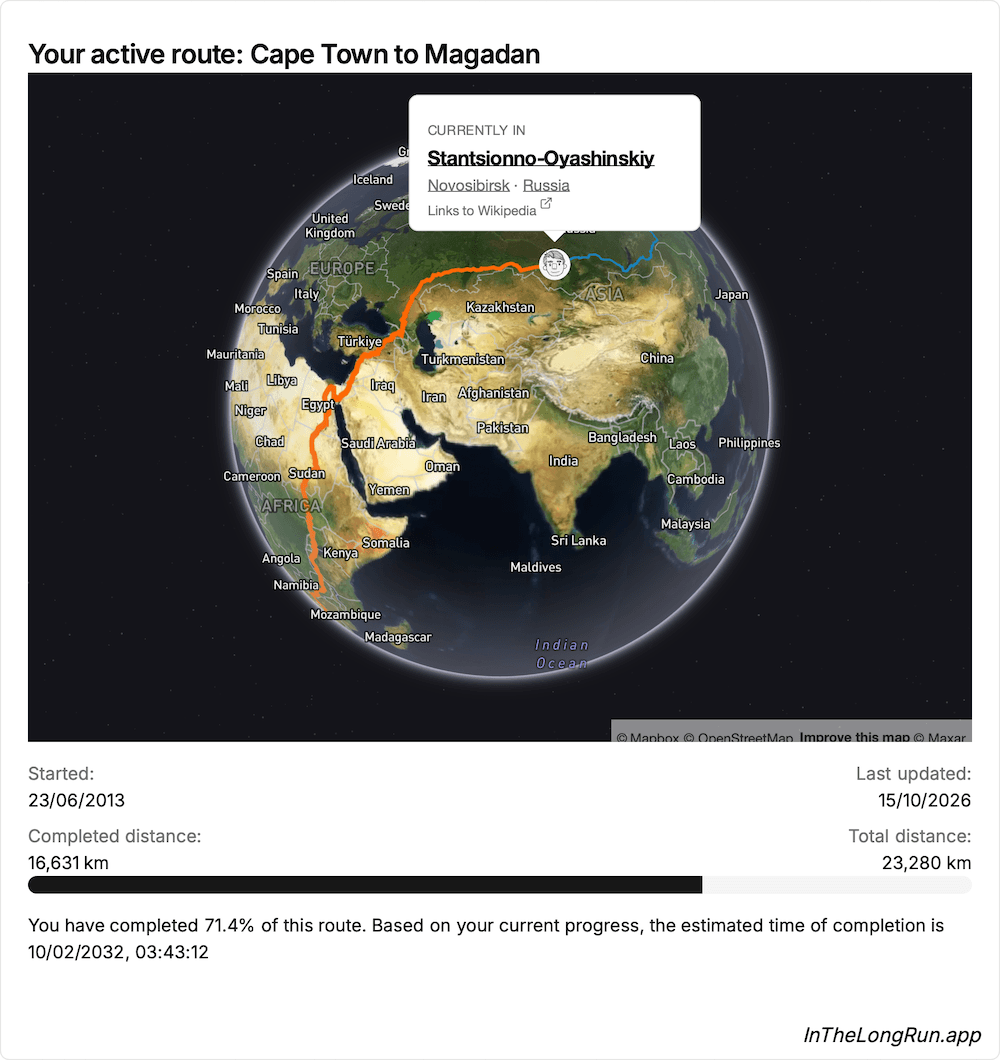
Every fitness app and half of the influencers on Instagram tell me the sub-20 is a few weeks of vo2max training away. My year is evidence to the contrary. Some weeks the goal is plainly discouraging. But then I remember that all of those threshold sessions, 5x1k repeats and slow recovery jogs have also moved me hundreds of kilometres along my route from South Africa to Eastern Russia.
In 13 years of running the route has taken me through 13 countries, teaching me geography and history as I poke around maps and Wikipedia links. It's motivating when I can't hit those interval paces or when the autumn weather starts to bum me out.
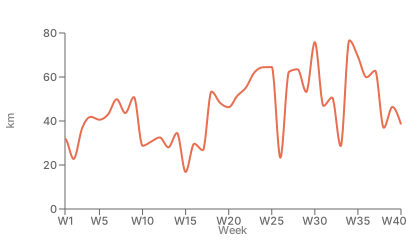
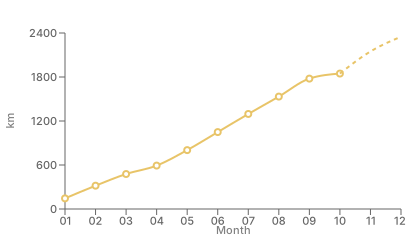
My race goals may barely budge, my weekly distance is like a yoyo, but long term I'm making progress. I can see the bad patch in the chart if I look for it, but on the map I can also see that it did not matter.
A goal measured in thousands of kilometres over years holds up against the ordinary facts of being a person with a body, a job, family, friends and other obligations in ways that a goal measured in sessions per week does not. One of them can be ruined by a bad Tuesday. The other cannot.
That's not to say the 5k goal isn't motivating. Races, paces or distances I'm trying to hit are all motivating. Seeing the progress on those is what makes running fun. My long virtual route is a good fallback, another leg under my running stool, so that I can keep hitting my short term goals long into the future.
Start a route
Pick something long enough that a bad month is noise. Our shortest routes are a few hundred kilometres while the longest is 27,918 km; the Via Francigena at 2,136 km is about a year at 40 km a week, and Te Araroa or the Pacific Crest Trail are two to three year projects that still move visibly every week.
Then connect Strava once and carry on running exactly as you were. If you want the mechanics first, what is virtual running explains how the distance gets counted, or you can just browse the routes and pick a map you want to look at for the next few years.
Nothing you do this week will finish it, and nothing you fail to do this week can break it.
Happy running!
Image credit: Ryoji Iwata | Unsplash
- A self-compassionate and helpful hack here is to allow yourself to break the streak once per period, i.e. the general rule is "read a chapter every day" but skipping one day is an expected and allowed failure mode. ↩
Blog posts are written by and in collaboration with large language models (LLMs) / AI.